Oct 27, 2026
Content
Benzamidine hydrochloride (often written as benzamidine HCl) is a small, water-soluble molecule that works as a reversible, competitive inhibitor of serine proteases. Its structure mimics the side chain of arginine, so it slips into the substrate-binding pocket of enzymes such as trypsin and blocks them from cutting your protein of interest. Because it is cheap, easy to dissolve, and gentle on most proteins, it has become a routine additive in lysis buffers, purification buffers, and crystallization solutions.
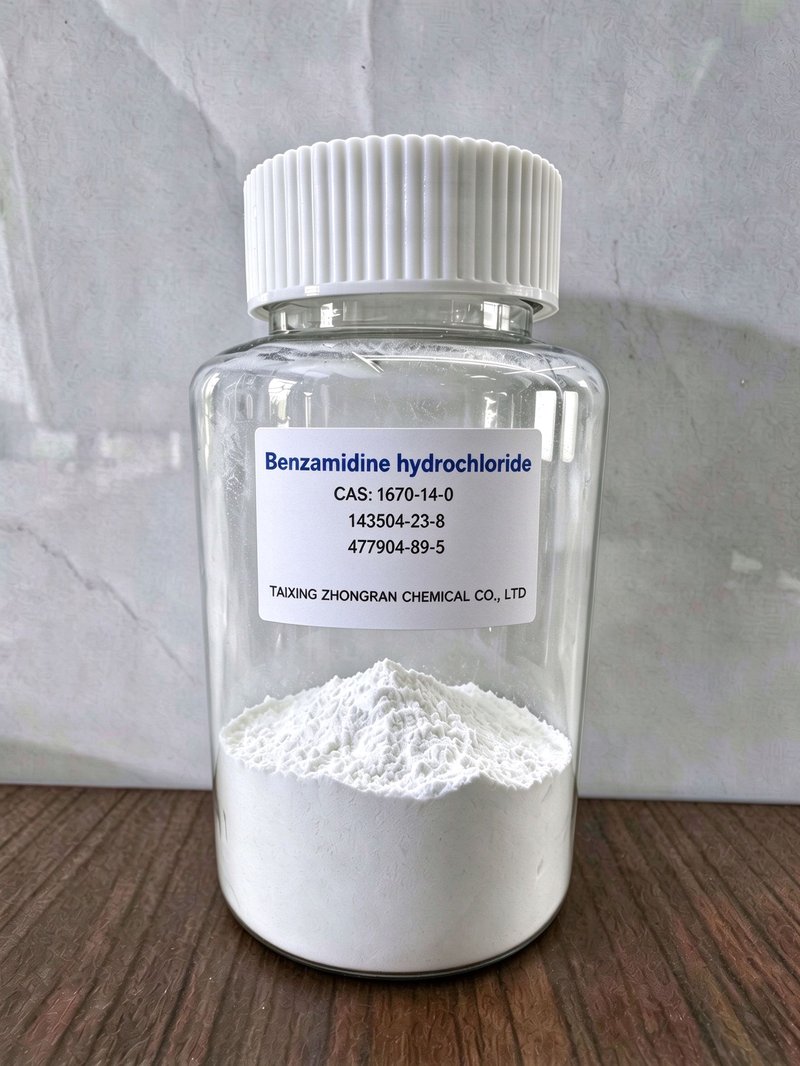
The compound is sold as an off-white to white crystalline powder, either as the anhydrous salt or as benzamidine hydrochloride hydrate. The two forms behave the same in the tube, but their molecular weights differ, so you must check the label before weighing. Getting this detail wrong is one of the most common reasons a "1 mM" solution ends up at the wrong concentration.
The table below summarizes the properties most researchers need when planning an experiment. Always confirm the exact values on the certificate of analysis from your supplier, since hydration level can vary between lots.
| Property | Typical Value |
| Chemical name | Benzamidine hydrochloride (benzamidine HCl) |
| Molecular formula | C7H8N2·HCl (anhydrous) |
| Molecular weight | About 156.6 g/mol (anhydrous); about 174.6 g/mol (monohydrate) |
| Appearance | White to off-white crystalline powder |
| Solubility | Readily soluble in water |
| Inhibition type | Reversible, competitive |
| Main targets | Trypsin, thrombin, plasmin, and other trypsin-like serine proteases |
| Storage of powder | Cool, dry, tightly closed (it absorbs moisture) |
Benzamidine competes with the natural substrate for the same pocket in the protease. Its inhibition constant for trypsin is in the micromolar range, which is why working concentrations of around 1 mM are enough to shut down most unwanted activity in a crude extract. Because the binding is reversible, the inhibitor can be removed later by dialysis, desalting, or buffer exchange, and the protease activity returns. This is helpful when you need to run an enzymatic assay after purification.
Benzamidine hydrochloride targets trypsin-like serine proteases only. It has little effect on cysteine proteases such as papain or cathepsins, aspartic proteases such as pepsin, or metalloproteases. If your sample comes from tissue or cells rich in a mix of protease classes, benzamidine alone will not protect your protein, and you should combine it with other inhibitors.
The right dose depends on how much protease activity your sample carries. Plant tissue, pancreatic extracts, and bacterial lysates often need more than clean recombinant protein preparations. The ranges below are common starting points, so optimize them for your own system.
| Application | Typical Concentration | Note |
| Cell or tissue lysis buffer | 1 mM | Add fresh just before use |
| Protein purification buffers | 0.5 to 1 mM | Keep in early steps where proteases are abundant |
| Protein crystallization | 1 to 5 mM | Prevents slow degradation over days or weeks |
| Elution from benzamidine affinity resin | 10 to 50 mM | Competitive elution of bound serine proteases |
A 100 mM stock is convenient because it can be diluted 1:100 to reach 1 mM in your buffer. Follow these steps for a clean, reliable solution.
Benzamidine hydrochloride solutions can lose potency over time, especially at room temperature and in the presence of air, so fresh or recently thawed aliquots give the most consistent results. Some labs flush the stock with an inert gas or simply prepare it new each week for sensitive work.
Because benzamidine covers only part of the protease landscape, it works best as one member of a team. A broad-spectrum setup often combines it with inhibitors that cover the remaining classes.
Ready-made protease inhibitor cocktails already contain several of these. If you use a cocktail, check its composition first, since adding extra benzamidine may be unnecessary or, for some downstream assays, unwanted.
Benzamidine is also useful as a ligand rather than a free additive. Resins in which benzamidine is covalently attached to agarose beads can capture trypsin-like serine proteases directly from a sample. This is a popular step for removing thrombin or factor Xa after tag cleavage, and for purifying trypsin and related enzymes from crude mixtures.
Equilibrate the column with a neutral to slightly alkaline buffer containing around 0.5 M NaCl to reduce non-specific ionic binding. Load the sample, wash until the baseline is stable, and elute either by lowering the pH (for example, with a glycine buffer near pH 3), by adding free benzamidine hydrochloride at 10 to 50 mM, or by using a high-salt step. Neutralize low-pH fractions immediately so the enzyme is not damaged.
Outside protein work, benzamidine hydrochloride serves as a building block in organic synthesis. Its amidine group readily condenses with 1,3-dicarbonyl compounds and related partners, which makes it a common starting material for pyrimidines, imidazoles, and triazines used in pharmaceutical and agrochemical research. In structural biology, it is also soaked into or co-crystallized with serine proteases to reveal how inhibitors sit in the active site, and it can be added to crystallization drops simply to keep the protein intact during long setups.
The most frequent error is mixing up the anhydrous and hydrate forms, which shifts the final concentration by roughly 10 percent. Another is relying on benzamidine alone for samples that contain several protease classes, which leaves the protein exposed. Researchers also sometimes forget that the inhibitor is reversible: if it is removed during dialysis or a desalting step and the protease is still present, degradation can resume. Finally, using an old, room-temperature stock solution can quietly reduce protection, so keep aliquots frozen and add the inhibitor fresh to the buffer.
Benzamidine is the free base, while benzamidine hydrochloride is its salt form. The salt is preferred in labs because it is more stable and dissolves easily in water.
It is mainly used in extracts and purification rather than live cultures. If you plan to add it to cells, test for toxicity at your intended concentration first.
Because it binds reversibly and is a small molecule, dialysis, desalting columns, or ultrafiltration with buffer exchange will remove it effectively.

jessica@zrtxchem.com
yufuli@zrtxchem.com
pengzhang@zrtxchem.com

+86-18013456125
+86-13951149388
+86-18252654234

Zhongran Foreign Trade Building, 68 Jiangping Middle Road, Taixing City, Jiangsu Province, China




 English
 Español
 日本語