Nov 06, 2026
Content
4-Methoxybenzoyl Chloride, also sold as p-anisoyl chloride or 4-methoxybenzoic acid chloride, is a widely used acylating reagent in organic synthesis. It is built on a benzene ring carrying a methoxy group at one end and a reactive acid chloride group at the other. This combination lets chemists attach the 4-methoxybenzoyl group to amines, alcohols and aromatic rings in just one step. This guide covers its key properties, preparation, typical reactions, storage and safety, so you can use it with confidence.
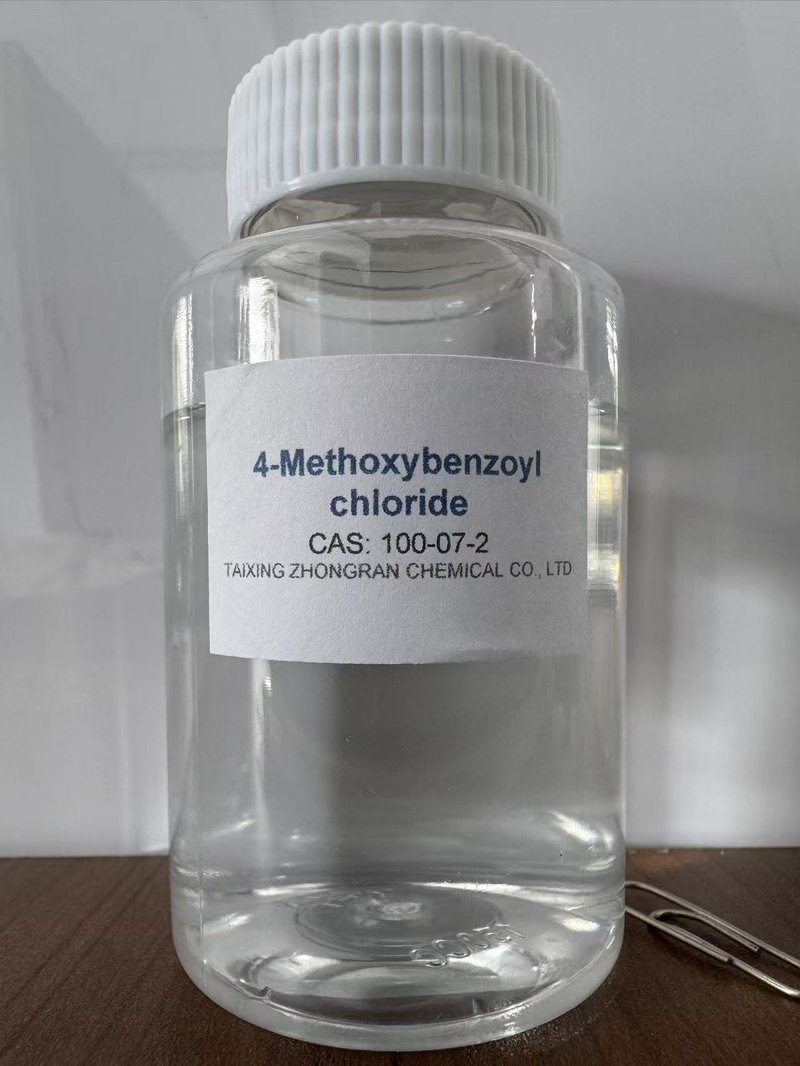
4-Methoxybenzoyl Chloride (CAS 100-07-2) has the molecular formula C8H7ClO2 and a molecular weight of about 170.59 g/mol. At room temperature it appears as a colorless to pale yellow liquid or a low-melting solid, because its melting point sits close to normal room temperature. It has a sharp, irritating odor and fumes slightly in moist air, which is a sign that it is reacting with water vapor to form hydrogen chloride.
You may see it listed under several names. Common variations include p-anisoyl chloride, anisoyl chloride, p-methoxybenzoyl chloride and 4-methoxybenzoic acid chloride. All of these refer to the same compound, so always confirm the CAS number when ordering to avoid mix-ups with the ortho (2-) or meta (3-) isomers.
| Property | Typical Value |
| CAS Number | 100-07-2 |
| Molecular Formula | C8H7ClO2 |
| Molecular Weight | 170.59 g/mol |
| Appearance | Colorless to light yellow liquid or low-melting solid |
| Melting Point | Approx. 22–23 °C |
| Density | Approx. 1.26 g/mL at 25 °C |
| Moisture Sensitivity | High, hydrolyzes to 4-methoxybenzoic acid and HCl |
The standard route starts from 4-methoxybenzoic acid (anisic acid), a stable and inexpensive solid. The carboxylic acid group is converted into an acid chloride using a chlorinating agent. Because the byproducts of the common methods are gases, the product is often easy to isolate.
4-Methoxybenzoic acid is heated with an excess of thionyl chloride, often with a drop of DMF as a catalyst. Sulfur dioxide and hydrogen chloride escape as gases, and the leftover thionyl chloride is removed under reduced pressure. The crude 4-Methoxybenzoyl Chloride can then be distilled under vacuum for higher purity.
For small-scale or sensitive work, oxalyl chloride in dichloromethane with catalytic DMF works at or below room temperature. It is gentler than refluxing thionyl chloride and produces only carbon monoxide, carbon dioxide and HCl as byproducts. All such preparations must be done in a well-ventilated fume hood.
The acid chloride group is highly electrophilic, so 4-Methoxybenzoyl Chloride reacts readily with a wide range of nucleophiles. The para-methoxy group donates electron density into the ring, which makes the carbonyl slightly less reactive than plain benzoyl chloride. This often gives cleaner, more controllable reactions.
Dissolve the amine and a slight excess of base in a dry solvent such as dichloromethane or THF, cool the mixture to about 0 °C, and add the acid chloride slowly, either neat or as a solution. Letting the mixture warm to room temperature and stirring for a few hours is usually enough. Dry glassware and solvents are essential, since any water competes with your amine and lowers the yield by forming 4-methoxybenzoic acid.
Because 4-Methoxybenzoyl Chloride reacts with moisture, poor storage is the most common reason it degrades. A bottle that has partly hydrolyzed will often show white crystals of 4-methoxybenzoic acid and a stronger smell of HCl.
4-Methoxybenzoyl Chloride is corrosive and can cause severe skin burns and eye damage. Its vapors, along with the HCl released on contact with moisture, irritate the nose, throat and lungs. Always work in a fume hood and wear chemical-resistant gloves, splash goggles and a lab coat.
If skin contact occurs, rinse with plenty of water for at least 15 minutes and seek medical advice. For eye contact, flush with water and get medical attention immediately. Small residues should be quenched carefully and slowly with a suitable alcohol or cold aqueous base inside the hood, then disposed of as chemical waste according to your institution's rules and local regulations. Always read the supplier's Safety Data Sheet before use.
Purity matters, especially in multi-step syntheses where impurities carry through. Most suppliers offer 98% or higher purity. Ask for a certificate of analysis and a recent batch number, and check the packaging for tight, moisture-proof sealing.
4-Methoxybenzoyl Chloride is a dependable, versatile building block for anyone who needs to introduce a 4-methoxybenzoyl group into a molecule. Understanding how p-anisoyl chloride is made, how it behaves with amines, alcohols and aromatic rings, and how to keep it dry and handle it safely will save time, improve yields and reduce risk. With good storage habits and careful technique, it will perform reliably in both research and scale-up work.

jessica@zrtxchem.com
yufuli@zrtxchem.com
pengzhang@zrtxchem.com

+86-18013456125
+86-13951149388
+86-18252654234

Zhongran Foreign Trade Building, 68 Jiangping Middle Road, Taixing City, Jiangsu Province, China




 English
 Español
 日本語