Oct 27, 2026
Content
If you work with heterocyclic chemistry, you will sooner or later run into 4-Bromomethyl-1,2-Dihydroquinoline-2-One. It is also written as 4-(bromomethyl)quinolin-2(1H)-one, 4-bromomethyl-2-quinolone, or 4-bromomethyl-2(1H)-quinolinone. The names differ, but they describe the same small molecule: a quinolinone ring with a reactive CH2Br group at the 4-position. This guide covers what the compound is good for, how it behaves in the flask, and what to check before you buy or use it.
The core of the molecule is a 2-quinolone (also called carbostyril), which is a benzene ring fused to a six-membered lactam ring. The "1,2-dihydro...2-one" part of the name tells you that the nitrogen carries a hydrogen and that position 2 is a carbonyl. At position 4 sits a bromomethyl group. The molecular formula is C10H8BrNO and the molecular weight is about 238.08 g/mol.
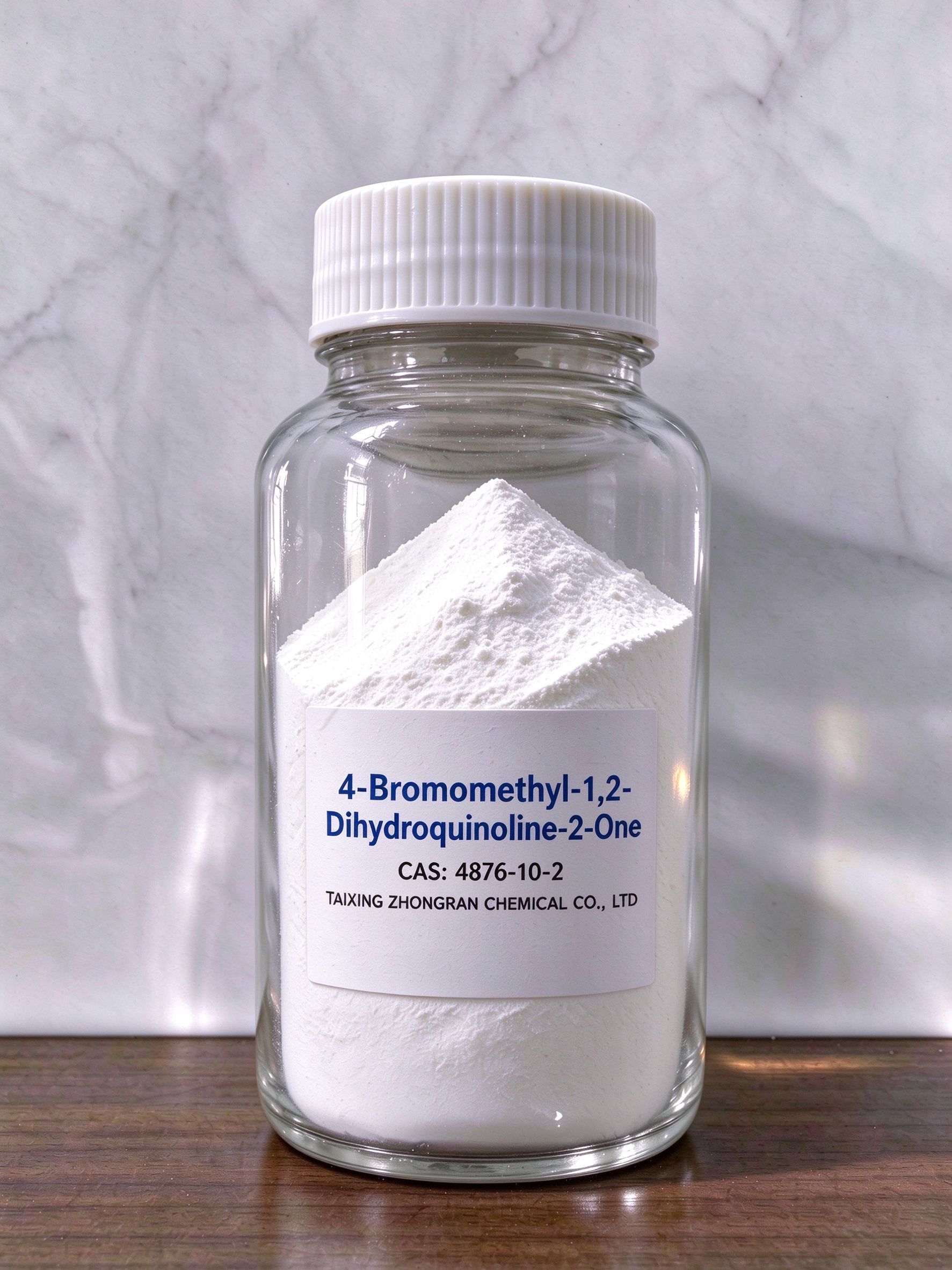
The compound is usually supplied as an off-white to pale yellow solid. It is best thought of as a building block. The quinolinone scaffold appears in many bioactive molecules, and the bromomethyl handle lets you attach that scaffold to almost any nucleophile in one step.
The table below summarizes the basic information most people look for first. Always check the certificate of analysis from your own supplier, because physical data can vary with purity and crystal form.
| Property | Typical Information |
| Common names | 4-(Bromomethyl)quinolin-2(1H)-one; 4-bromomethyl-2-quinolone |
| Molecular formula | C10H8BrNO |
| Molecular weight | About 238.08 g/mol |
| Appearance | White to light yellow crystalline solid |
| Solubility | Better in DMF, DMSO and hot alcohols; poor in water and hexane |
| Reactive site | Benzylic-type C–Br bond on the 4-methyl group |
The CH2Br group is attached to an electron-poor, conjugated ring system, so it behaves much like a benzyl bromide. Bromide is a good leaving group, and the carbon is easy to reach, so SN2-type substitution tends to be fast and clean under mild conditions. That reactivity is the main reason chemists choose 4-bromomethyl-2-quinolone over the 4-methyl or 4-hydroxymethyl analogues.
Because the bromide can be swapped for many nucleophiles, a single batch of 4-Bromomethyl-1,2-Dihydroquinoline-2-One can feed an entire library of analogues. This is useful in early-stage medicinal chemistry, where you want to test many side chains on the same core.
The ring N–H can be deprotonated by a base. Under strongly basic conditions, one molecule can alkylate another, which gives dimers or oligomers. When you plan a reaction, use a mild base and add it carefully, or protect the nitrogen if the route allows.
Most laboratories either buy the compound or make it from a simpler precursor. Two routes are widely described in the literature.
Whichever route you use, purify the product promptly by recrystallization or short-column chromatography. Residual succinimide, dibromo by-products, and unreacted starting material are the usual impurities.
The table lists the most common transformations. Conditions are general starting points and should be tuned for your substrate.
| Nucleophile | Product Type | Typical Conditions |
| Primary or secondary amines | 4-(Aminomethyl)quinolinones | K2CO3 or Et3N, DMF or MeCN, room temperature to 60 °C |
| Thiols | Thioethers | Mild base, DMF, room temperature |
| Phenols and alcohols | Ethers | K2CO3 or Cs2CO3, acetone or DMF, mild heating |
| Carboxylate salts | Esters | Carboxylic acid plus base, DMF or MeCN, sometimes a crown ether |
| Sodium azide | 4-(Azidomethyl)quinolinones | DMF or DMSO, room temperature; useful for click chemistry |
| Triphenylphosphine | Phosphonium salts | Toluene or MeCN, heating; precursors for Wittig reactions |
The 2-quinolone ring is a well-known scaffold in drug discovery research. Researchers use 4-(bromomethyl)quinolin-2(1H)-one to attach amines, heterocycles, and linkers at the 4-position and then screen the products for biological activity. Its role is that of a building block, not a finished active ingredient.
Quinolinones are fluorescent, and bromomethyl-substituted aromatic reagents are classic tools for tagging carboxylic acids and other nucleophiles before HPLC analysis. Bromomethyl quinolinone derivatives can be explored along the same lines, so that trace analytes become easier to detect.
The planar, hydrogen-bonding quinolinone unit is also used in dyes, coordination ligands, and functional polymers. The bromomethyl group provides a simple way to anchor the unit onto a larger structure.
Alkylating agents of this type should be treated with respect. Benzylic-type bromides are typically irritating to the skin, eyes, and respiratory tract, and some are lachrymatory. Read the supplier's safety data sheet before opening the bottle, and follow your institution's rules.
Quality problems with this compound usually show up as poor yields or messy reactions later on. A few checks at the purchasing stage can save a lot of trouble.
If a substitution reaction gives low yield, first check whether the starting bromide has partly hydrolyzed to the hydroxymethyl compound. A quick TLC or NMR will show this. If you see dimers or a gummy by-product, the lactam N–H is probably being alkylated, so lower the base strength, reduce the temperature, or add the bromide slowly to an excess of the nucleophile.
Poor solubility is another common issue. Switch to DMF or DMSO, or warm the mixture gently. With the right solvent, a mild base, and a fresh batch of 4-bromomethyl-2-quinolone, most substitutions finish within a few hours.
4-Bromomethyl-1,2-Dihydroquinoline-2-One is valuable because it combines a stable, biologically relevant quinolinone core with a highly reactive handle. That makes it a good choice for building compound libraries, preparing fluorescent probes, and designing new functional molecules. Buy it from a reliable source, store it cold and dry, handle it as an alkylating agent, and it will serve you well as a versatile intermediate.

jessica@zrtxchem.com
yufuli@zrtxchem.com
pengzhang@zrtxchem.com

+86-18013456125
+86-13951149388
+86-18252654234

Zhongran Foreign Trade Building, 68 Jiangping Middle Road, Taixing City, Jiangsu Province, China




 English
 Español
 日本語